Poultry Problems

If you keep chickens, ducks, or turkeys on your homestead, I’m guessing you are paying close attention to all the reports and information circulating about HPAI – highly pathogenic avian influenza. This is the first time I’ve had chickens to worry about when an avian flu is widespread. It’s also strange to me that there have been a few odd sicknesses impacting birds over the last year. Something’s happening here… what it is ain’t exactly clear…

I’ve read a number of articles just to understand what precautions I could and should take to help protect my flock. To be completely honest, it’s quite confusing and I haven’t found anything to be that useful or clear with regard to prevention. I’m still not sure if there is anything I can do that will make a difference or if it’s just luck or bad luck of the draw as to whether your flock gets infected. Sadly, I did get an email from Murray McMurray Hatchery, who I had placed an order with in the winter for another 15 chicks, and they had a confirmed positive test for HPAI in one of their barns. Which means I won’t be getting the silver and golden Polish chicks I ordered, or the golden and blue laced Wyandottes. How sad for them. Truly tragic.

In the hopes of saving even one person from this heartache, here are the tips I’ve found.  These seem like standard good hygiene practices to follow all the time.

  1. Minimize the risk of contamination from outside your coop to inside your coop by doing the following:
    • Wash your shoes/boots before entering or wear shoe covers.
    • Use equipment and gear specific to your flock and nothing else.
    • Keep feeders and waterers in your coop so that wild birds aren’t using them.
  2. Keep your feeders and waterers clean by washing them often.
  3. Cover your pen or run so that droppings from wild birds can’t contaminate their space.
  4. Wild waterfowl carry high levels of the HPAI virus. Keep ducks and geese away from your flock. If you raise ducks, keep them separate from your other flocks.
  5. Only buy new birds from a trusted source, e.g. not craigslist.
  6. Watch your flock closely for any signs of illness and report it to your veterinarian and local cooperative extension office immediately.  Signs to look for include: lack of energy and appetite, lowered egg production, misshapen eggs, discolored comb and wattles, diarrhea or sudden death. 
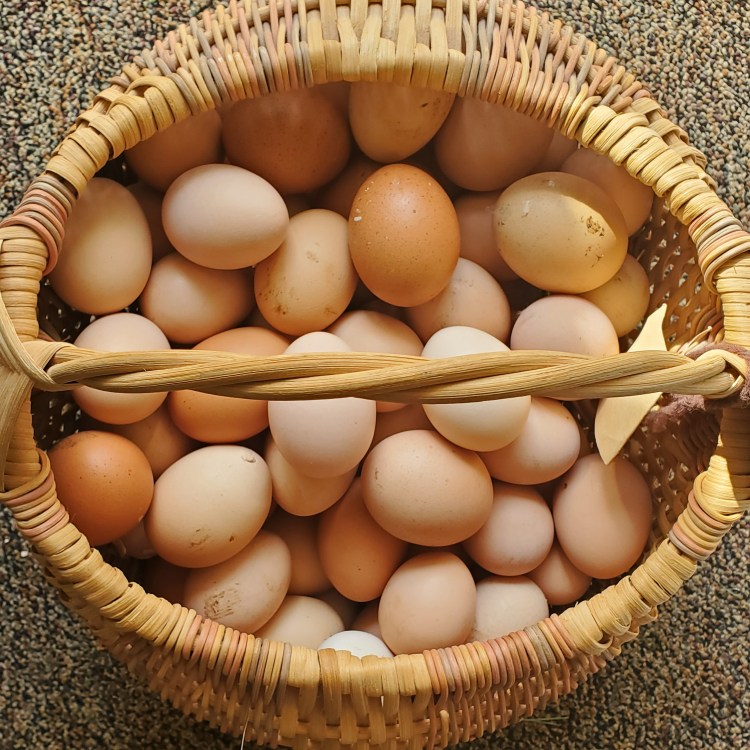
Egg Basket full of three dozen eggs

Has HPAI impacted your flock? What have you done to protect your birds? Please share any advice that will help all of us stay safe.

Cock-A-Doodle-Doo To You

If I asked you to close your eyes and picture a smart, regal, gentlemanly, and protective farm animal, what comes to mind? A horse. A duck. A cat. All of those answers could be correct, but it’s not the one I’m thinking about.

Last November I started looking online for a new canine member to join our family. As you may recall, that is how we came to have Molly (aka Ms. Mess – she is the messiest and most bizarre eater I have ever come across but that is a story for another day). As I was searching, I regularly checked our county’s animal control and adoption center. I kept seeing a rooster in their listings and told myself if he was still available for adoption at the end of the year, I would go see him. Well, you’ll never guess what happened…

I had the week off between Christmas and New Year’s so on December 30 I made an appointment to go meet him with my girls. I told them they would decide if we applied to adopt him based on what they thought of his personality and temperament. I wanted them to have a vote in the process and to be sure they would still feel comfortable going in the chicken coop (with supervision, of course). I had to like him too.

The staff who took us to his kennel said we were the first people to visit him and he had been there since October. So sad! He was being kept in the most isolated kennel so that dogs weren’t right next to him. This meant he was in the far back corner with three out of four walls made of concrete, a chain link fence entrance, and fluorescent lighting. No natural light whatsoever. And I don’t mean this in any way to denigrate the conditions – it was clean, he had a perch, and food. My point is this was far from an ideal chicken habitat and I immediately felt sorry for him.

The woman walked in the kennel and picked him right up like he was a bunny. I was so amazed. She said he was friendly and easy to be around and hadn’t been aggressive at all. The girls petted his neck feathers and quickly lost interest, then went to check out other dogs in nearby kennels. I asked the staff member some questions about his demeanor and other things she knew about rooster behavior. Honestly, I didn’t have much beyond “Is he an a-hole?” because I’ve dealt with the man fighters and didn’t want that again. She didn’t seem to think this was his personality but of course you can’t be sure until he’s in a flock and his territorial instincts kick in.

I filled out an application and they said we might hear back as soon as the next day, December 31 but more likely Monday, January 4. I was kind of like, “Umm, he’s had no visitors in three months… what do you need to verify?” but it was totally fine. They wanted to confirm that my other pets are licensed and vaccinated as proof that I’m not a horrible pet owner. I get it.

Over the weekend I watched a bunch of rooster taming videos and got an idea of how I would approach being the alpha rooster. On Monday we got the call that we were approved to adopt him and I went to go get him. We kept him isolated from the flockers for five days and each day I spent time picking him up and carrying him around so that we could bond. It was grand! I’m being 100% serious. It was a really good confidence builder for me and I think made him realize I’m in charge. Ha!

I’m not in complete agreement with how he has his way with the ladies, but he lets them eat first and seems to put himself between the flock and the cats when they wander into the coop so I think he’s doing a good job.

Meet Roger!