Getting the Garden in the Ground

It feels like a lot has happened in the last two weeks. COVID-19 appears to be slightly loosening its grip on our daily lives and that’s hopeful. I know that isn’t the case everywhere and I’m certainly not supporting any premature relaxing of restrictions – the digital signage on the highway where I live still says “safer at home.” I personally think this virus will play a starring role on the global stage for at least another year. But I’ve been trying to focus on the things within my control and what I can influence to stay healthy. Ups and downs though, like everything. Rarely is anything in my life a linear and even paced arrow toward a target.

I got all my plants in the ground between May 14 and May 19. This gave a very generous three-week window after the last average frost date of April 21. I have read that giving a little extra time can be the difference between success and a lot of disappointment. With the weather here in the mid-Atlantic so wet and much cooler than normal I was in no rush.  I think it was the right call.

Here’s what I got done –

  • Peppers – my seedlings were not as strong as I would have hoped but I just had to plant them and see if they hang on.  If not, I’ll have to buy a few starts from the nursery.
  • Tomatoes – my seedlings never really advanced beyond the spindly, thin stage. After the second set of leaves came in, that was sort of it.  In hindsight, I don’t think I had enough nutrition in my growing medium. I opted to go by six heirloom plants from the nursery. I’m disappointed about this but it was a good learning for next year.
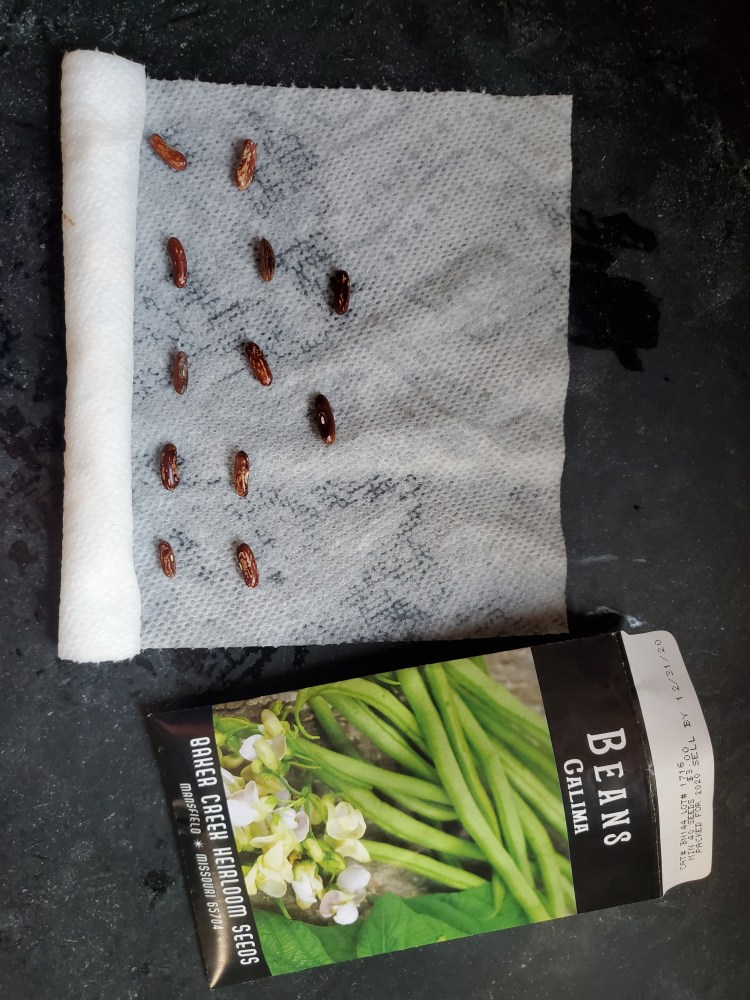
  • Beans – I’ve got three varieties of bush beans and one pole bean.  I learned last year to sprout them first, which only means wrapping them in a moist cloth (you can use a wash cloth, paper towel, cut up t-shirt, etc.) and leave them in a produce bag on the windowsill for a 2-3 days. Then gently remove them and plant them right away.
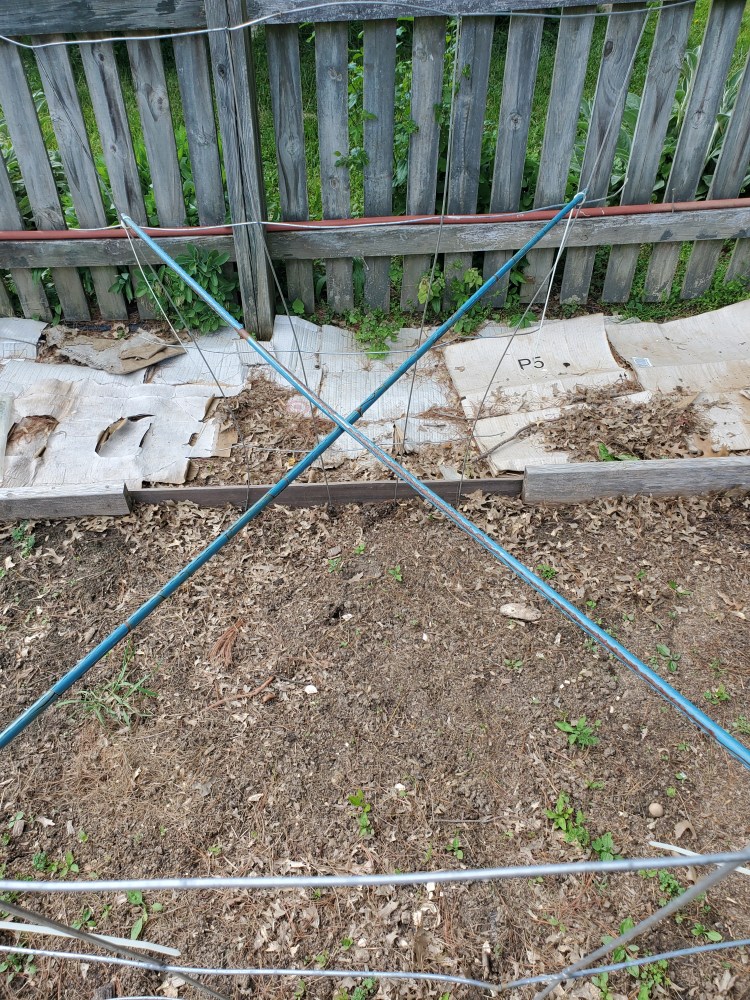
  • Cucumbers and Peas – built a trellis with old tomato cages by cutting the wire to essentially break the cage, bent them flat, and then zip tied a few old garden stakes across (see below).

You may recall the sadness and tragedy I experienced last year when deer ate all my luscious blueberries in one weekend.  Well, fool me once but not fool me twice. To ensure this doesn’t happen again, Cactus and I spent about four hours installing an electric fence around the berry patch. This is an area about 20×30 feet and we already had the poly wire and enough step in posts so hoped it would be a relatively easy project.  Cactus bought a solar powered fence charger from TSC and we figured it out pretty quickly watching this series of videos from McGregor Electric. The thing we had the most trouble with was determining what was grounding out the charge. I also wanted to expand our blueberry bounty so bought two additional bushes – Blue Gold and Duke. 

There’s a separate garden bed in the berry patch that I didn’t use last year, largely because it was free reign for the deer.  Since we got the fence installed, I decided to try corn, butternut squash and watermelon.

The black raspberry bushes are blooming beautifully and look way more full than last year. And fingers crossed that we’ll actually enjoy some figs this year. We put lots of leaves around the roots to keep them insulated during the winter and it was a very mild winter so it seems promising.
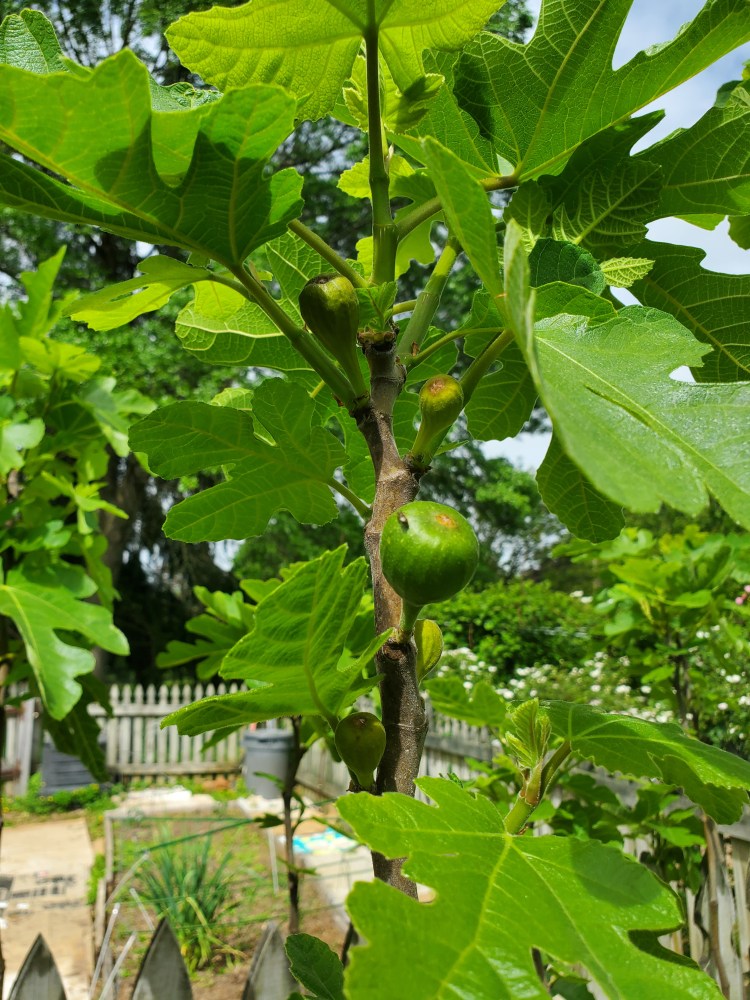
Close up of small fig growing on bush

How to Make a Trellis with Two Tomato Cages:

We’re Jammin’… and I hope you like jammin’ too

We have had quite a bounty of berries for weeks now.  It’s been such a delight to be able to walk outside and pick a bowlful of berries to have on the kitchen counter for some “walk by snacking” or for an after dinner treat with a little scoop of vanilla ice cream.  

Luckily, our berry bramble is growing extremely well and we already have more than we can reasonably eat so I wanted to preserve some of it.  The simplest option in my mind is freezing them. I know that I should lay them all out in a single layer on a sheet pan, let them freeze individually so as to not have one big clump, and then put them in a freezer bag. However, I have found that I don’t eat frozen berries all that often throughout the winter.  People always suggest throwing them in muffins or smoothies which are good ideas, I just don’t happen to do it.

Instead, I wanted to try my hand at canning some of these berries into jam.  I know absolutely nothing about canning and was curious how complex it might be.  I started by watching some videos on youtube of course and one of my go to bloggers is Melissa K. Norris and she has a whole 4-part series on canning that is free and extremely informative.  I also read about it on the National Center for Home Food Preservation site.

Then I figured I should just give it a go.  This whole year, and these first few years, are all experimental in my mind.  I don’t want to set much in the way of expectations because I truly don’t know what level of effort and involvement any of this requires and whether I have the time and ability to do it.  For me it’s going to be a matter of finding the things I get the most enjoyment from and that also serve my family well. I’m not gonna struggle to grow something that only I like and I’m not gonna fight the Earth to grow something that just doesn’t want to grow (except an avocado tree!  I am going to grow one, I just have to).

So here are the basic steps I followed for making and canning my first ever blackberry jam*.

Part 1 – The Berries

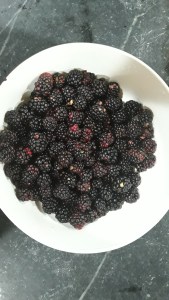
Gathered about 5 pounds of berries.  I tried to get a mix of pre-ripe and ripe so that the natural pectin would be sufficient without having to add any.  I don’t fully understand the pectin conversation so I’m just gonna have to play around until I figure out how to get the correct gel-like consistency.

Rinsed them in a strainer and removed any stems and leaves that were in the bunch.

Blackberries from the Farm Charm bushes

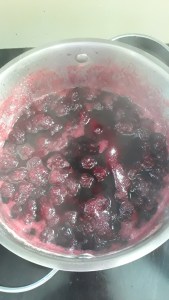
Placed them in a sauce pan on medium high heat with about a cup of sugar.  (Disclosure, I actually tried this about a week ago and got to this step, ran upstairs to put some clothes away while the berries were on the stove, and got distracted doing other things.  I could smell the berries from upstairs and they smelled like a beautiful berry wonderland until they didn’t. All of a sudden I could smell burning and they were a darkened charred mess in the pan.  Sooo, don’t do what I did.) I suggest staying close by and stirring the berries often to keep an eye on how quickly they are breaking down. It didn’t take more than 5-10 minutes, but this depends on the fruit you are using.

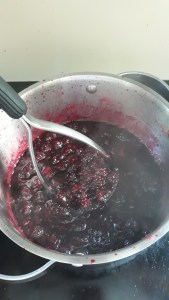
Simmering my berries
Cooking the blackberries for canning

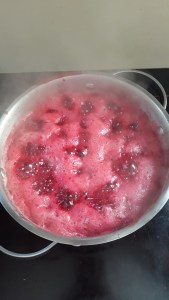
Mashed the berries a little so it was a uniform consistency and did the “spoon test” to check for done-ness.  I am not 100% confident the gelling happened to the correct degree but I’ll see what happens when we try the first jar of jelly.

Mashing blackberries
Spoon test for canning readiness

Part 2 – The Canning

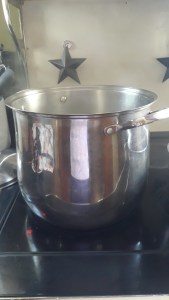
Sterilized my jars.  I filled up the biggest pot we have and boiled the water.  I carefully placed the Ball jars inside. I read to put a cloth in the bottom so that the jars don’t knock around so I did.  I do not have true water bath canner. Again, I’m a total newbie at all of this so before I start spending chunks of change on the right equipment (which I fully support), I’m being creative with the tools and equipment I have.  

My 20 quart pot for canning
Sterilizing canning jars

Removed the jars carefully and placed them on a clean towel on the counter to dry.  Placing the jars in the boiling water and removing them was when I wished I had the proper jar lifters.

Canning supplies

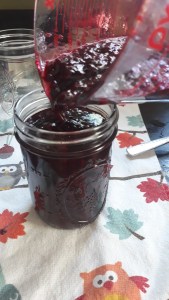
Filled the jars with the berry compote.  To minimize spills and drips, I ladled the berries from the saucepan into a Pyrex measuring cup with a spout that would ease pouring.

Blackberry jam in my 4 cup pyrex for easy pouring
Pouring my first jar of blackberry jam

Put the lids and rings on the jars and carefully placed them back in the boiling water for 5 minutes.  They had to be completely submerged in water with about ¼ of an inch covering them.

Removed them from the boiling water and tested the seal.  There was no clicking and I could lift up the jar by just holding on to the lid on and it was completely fine.

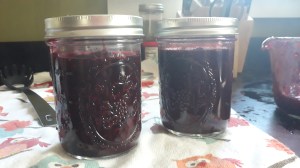
Two jars of homemade blackberry jam

Now I have four jars of blackberry jam.  What will I do with it? I’m a huge fan of PB&J so that’s an obvious one but I also think this would be excellent on blintzes for a yummy weekend breakfast or a dollop on top of a bowl of plain yogurt.  I’ll let you know what else I come up with.

*I’m not recommending you follow these steps exactly; definitely consult a reputable resource on canning.

Beetles and the Beans

Tale as old as time, true as it can be…  Just kidding, making a very dorky play on Beauty and the Beast with my post.  My green beans have been doing very well.  A number of people had told me to plant green beans as they were basically fool proof.  I love disclaimers like that because I can pretty much guarantee it won’t be that straightforward for me.

I had read that it was helpful to sprout the seeds in a moist towel for 2-3 days before directly sowing them in the ground.  That worked really well. I just used an old wash cloth, dampened it slightly, rolled about 12 seeds up, and left it on the kitchen counter in a produce bag from the grocery store so that it stayed warm and moist.  I checked it each day to make sure it was still damp and then three days later every seed had a sprout shooting out. Then I planted all the seeds outside.

I will say I did not follow the instructions on the packet regarding spacing.  I think I was just so happy that all seeds had sprouted and I wanted to use every last one.  I had only designated half of one of my garden beds to beans so this was about a 4×4 foot square that I planted 12 bean plants in.  Learning #1:  follow the instructions on plant spacing. I have learned it doesn’t do me any good to have a big jumble of plants that I won’t be able to tend.  The spacing recommendations are to allow each plant to grow and thrive. Sounds obvious, but so is a STOP sign and we don’t all follow those.    

Speaking of jumble, Learning #2:  doing a trellis or some other support structure for bean plants (and other vining or wandering plants) is necessary.  I really liked this video from Melissa Norris on building a teepee trellis and used this concept for my green beans.  However, I don’t think I built my two teepees tall enough.  My teepees were only about 4 feet tall so as the plants grew to the top, they just wound back down and became a big interwoven mix up.  Having too many plants probably also contributed to this scenario. I think what I will try next year is to plant one plant at the base of each leg of my teepee, not more than 6-8 plants, and make the teepee at least 5 feet tall.  I will also allot an entire garden bed to the beans and maybe just plant a few marigolds in the corners because….

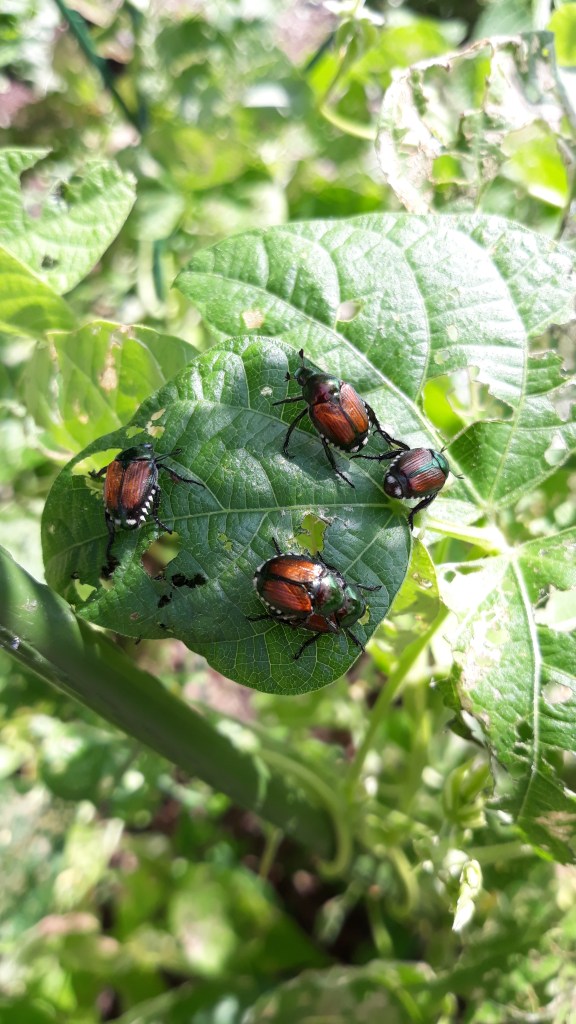
Four japanese beetles on bean leaf

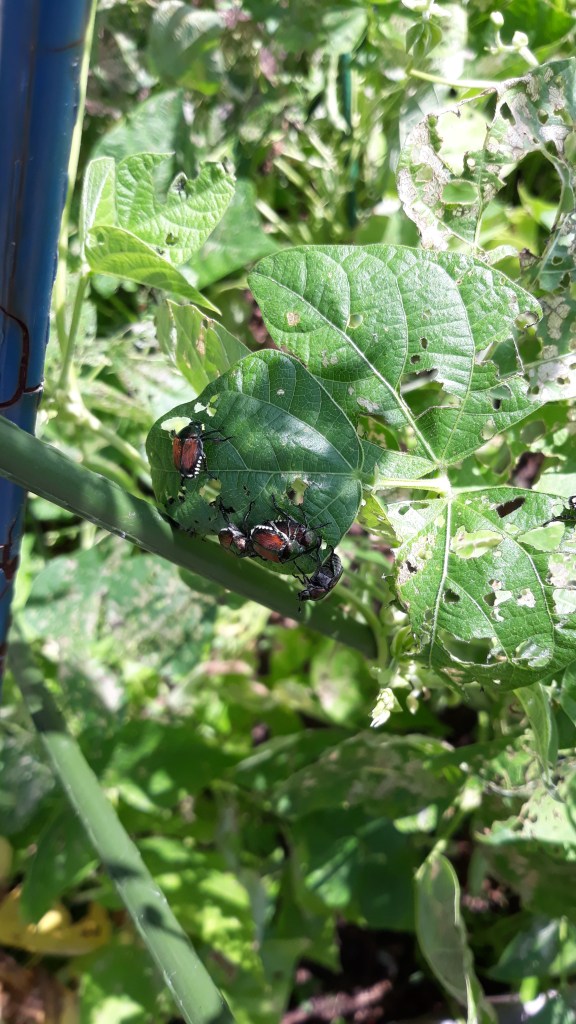
Learning #3:  Japanese beetles are no joke.  For about 2-3 weeks I was going out to my bean plants every few days and picking at least a 2 pounds of green beans.  I was noticing that the leaves were getting eaten but being the novice that I am, I wasn’t sure how much of that was par for the course.  I know there are going to be bugs and I’m pretty sure I don’t want to use any chemicals on the fruits and veggies that I grow, so I understand there will be some food sharing.  But dang! These beetles are greedy and destructive. One afternoon, I finally said wait a minute and while I was picking the beans I paid better attention to any bugs I could see.  And guess who was all up in my face, not even trying to be slick about their thievery? These guys! So I quickly googled and learned these are Japanese beetles, they are quite a nuisance, and there are a couple remedies to fight back.  The approach I chose was to knock them off the plants into a bucket of water, kind of like this guy from the Maine Co-op Extension.  That isn’t a long-term solution so I may look into some sort of spray or insecticidal soap next year but for now it’s all learning.  

Japanese beetles on bean leaf

That’s one of the main reasons I am trying to write as much of this stuff down.  I have no gardening experience whatsoever and it will take many years for me to get the hang of this stuff.  And if I try to rely on memory – FOR-GET-IT!!!

Berry Fest

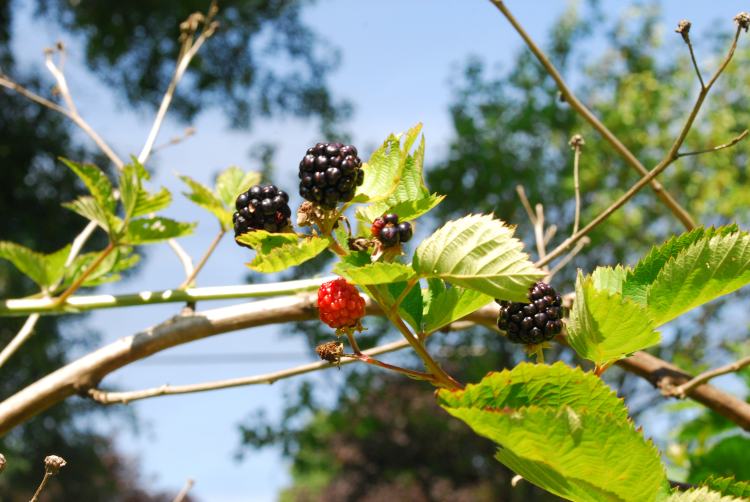
Three big juicy blackberries on Farm Charm

We have begun to reap quite a bounty of berries.  The previous owners of our property had a sizable berry establishment going.  There are a couple of massive blackberry bushes growing in one spot and then a tunnel of blackberry bushes; an entire forest of black raspberry bushes; and maybe three or four blueberry bushes. I also planted four strawberry plants but you may recall I had an issue with bunnies eating them.

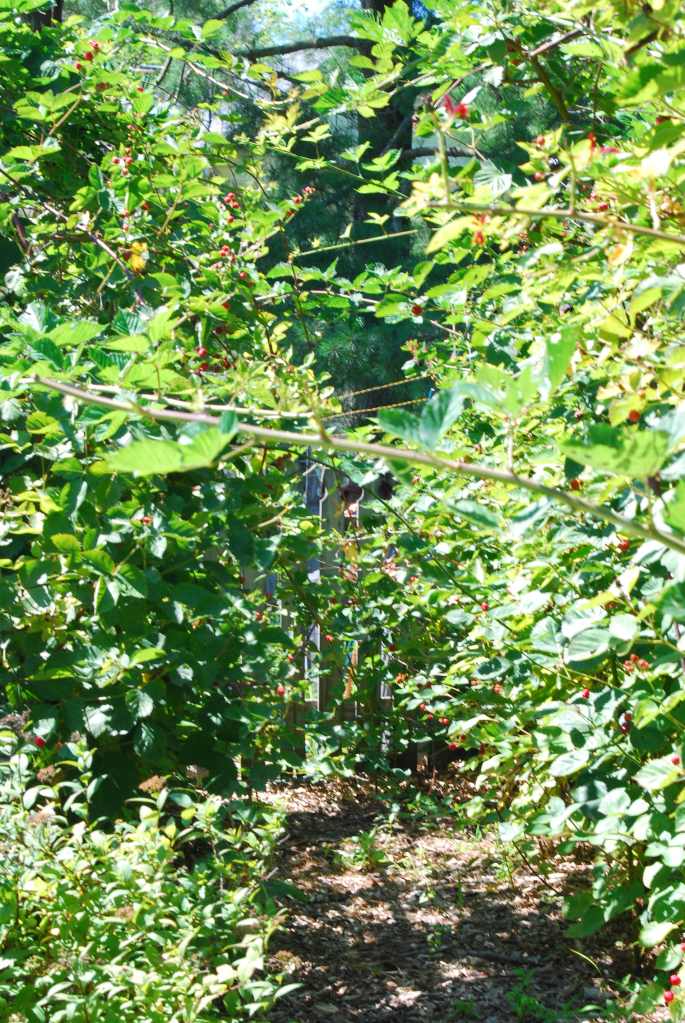
The blackberry bush tunnel on Farm Charm
The blackberry bush tunnel

As someone who is brand new to growing food, I am still learning how much effort and time is needed.  With regard to the berry bushes (and they are pretty hands off), should I be checking on them every day, every other day or is twice a week sufficient?  I am a schedule person and like knowing what I need to do each day. I’m sure it is my life’s lesson to realize that it’s not about checking things off, it’s about enjoying the process, but we can save that philosophizing for another day.

The outside of the blackberry bush tunnel on Farm Charm
The blackberry bush tunnel from the outside

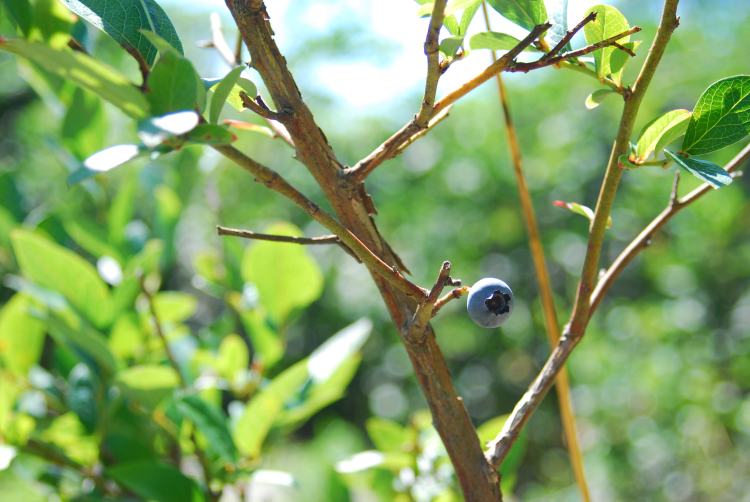
I’m also asking because I had a disappointing experience with the blueberries just a few days ago and wondering whether it could have been prevented had I been more vigilant.   I was watching them for about two weeks. The berries started small and green, then turned to grayish purple, then a light blue, and then a nice rich dark blue. On Friday evening, I could see that they were all getting very close to perfection and I wanted to wait one more day so they could be as juicy and plump as possible.  And then, for whatever reason, I didn’t do the picking on Saturday like I should have and when I went out Sunday morning, they were ALL GONE!  

The single blueberry that the deer left behind on Farm Charm
The lone blueberry that the deer left

I know the deer ate them, those punks!  We have an electric fence around the garden but I haven’t turned it on.  Up to this point it didn’t appear that the deer had been noshing on our fruit bushes.  But they must have been watching me watch the blueberries and picked the most opportune time to make their move.  Grrrrrr! 

So to my question about frequency.  Could I have prevented this by checking the berries on Saturday?  Maybe. To be on top of things, I should probably be checking on the things that are getting close to ripe every day during harvest season but I just know that isn’t going to be entirely realistic.  But the berries are worth it.

Three big juicy blackberries on Farm Charm

One morning I went out and collected about 6 cups of blackberries in about 10 minutes. 

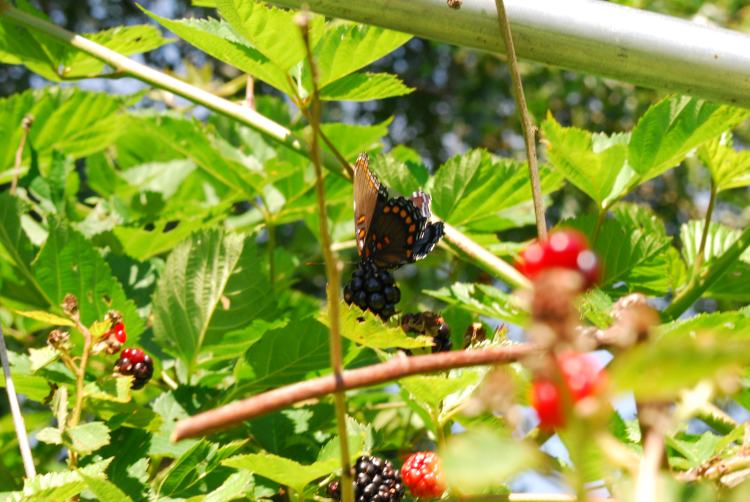
Swallowtail butterfly enjoying the Farm Charm blackberries

I have been reading up on canning from various other bloggers (Preparedness Mama and The Organic Prepper), and on this National Center for Home Food Preservation.  I’ll share how I made two cans of blackberry jam in about 45 minutes soon.

Berries upon berries at Farm Charm